
If you’re searching for FemiCore reviews, chances are you’re trying to answer one important question: can this daily supplement really support better urinary and bladder health?
With so many women’s wellness supplements available online, it’s understandable to be cautious. Marketing pages can make impressive promises, while independent information about ingredients, safety, and expected results can be much harder to find.
That’s exactly why this FemiCore review takes a closer look at the product.
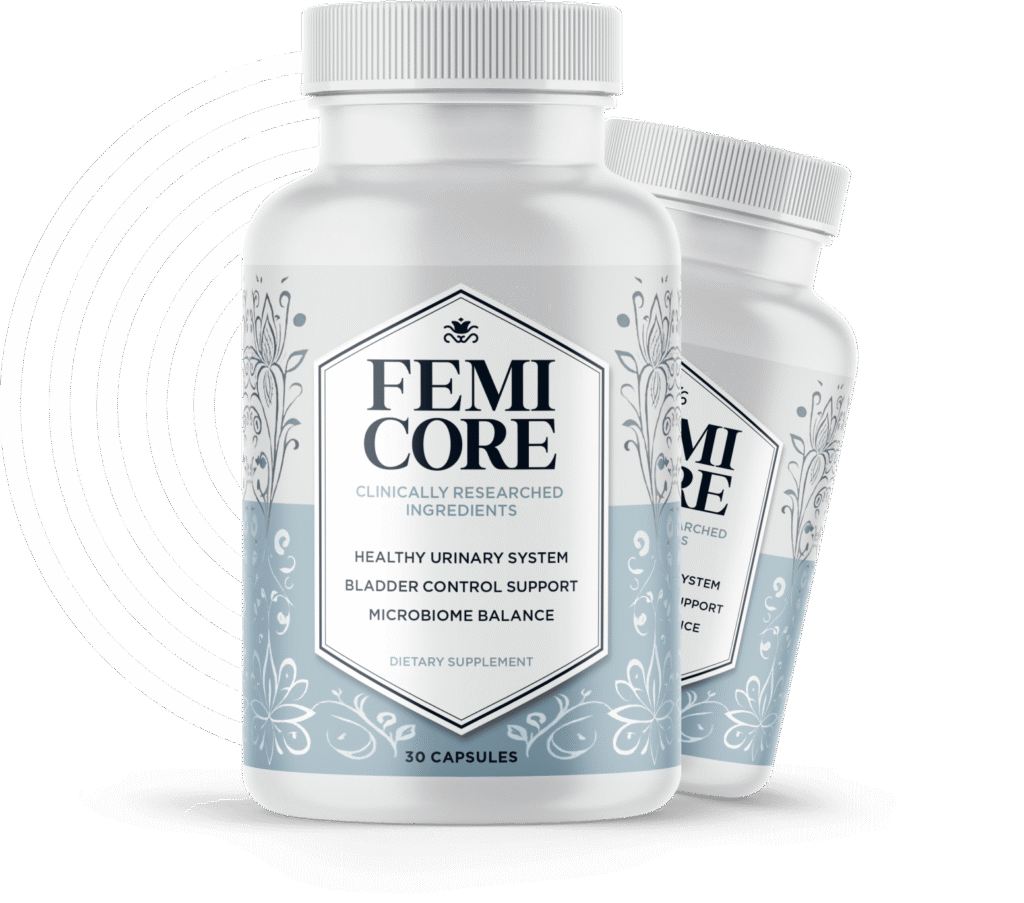
Rather than simply repeating promotional claims, we’ll examine what FemiCore is designed to do, what’s inside the formula, its potential benefits, possible side effects, how to use it, and what you should realistically expect.
Important: FemiCore is a dietary supplement, not a medication. It should not be used to diagnose, treat, cure, or prevent a urinary tract infection or any other medical condition. If you have symptoms of an active UTI, speak with a healthcare professional.
FemiCore Reviews: Quick Overview
FemiCore is marketed as a daily women’s wellness supplement focused on bladder support, urinary comfort, and microbiome balance.
The formula combines botanical ingredients with several Lactobacillus probiotic strains. The product is designed around the idea that supporting the urinary microbiome may contribute to overall urinary wellness.
The current product information describes FemiCore as:
- A daily capsule for women
- Focused on bladder and urinary wellness
- Built around botanical extracts and probiotics
- Stimulant-free
- Non-GMO, according to the brand
- Designed for consistent daily use
One detail is particularly important, though.
The product’s marketing should not be confused with clinical proof that FemiCore can prevent or treat a medical condition.
Key Takeaways
- FemiCore is marketed for women’s bladder and urinary wellness.
- Its current formula combines four botanical ingredients with five Lactobacillus strains.
- Cranberry and probiotic ingredients have been studied independently for aspects of urinary and vaginal health.
- There does not appear to be strong independent clinical evidence proving that the finished FemiCore formula prevents recurrent UTIs.
- FemiCore should not replace medical treatment for an active UTI.
- The product is intended as a supplement to a broader approach to women’s health.
What Is FemiCore?
FemiCore is a dietary supplement designed specifically for women’s urinary and bladder wellness.
According to the product information currently available online, the formula focuses on supporting a healthy urinary microbiome while also providing botanical ingredients traditionally associated with urinary wellness.
The product is presented as a convenient daily capsule rather than a treatment for an existing infection.
This distinction matters.
A supplement intended to support urinary health is very different from an antibiotic or other medical treatment prescribed for an active infection.
What Is FemiCore Designed to Support?
The brand positions FemiCore around several areas of women’s wellness, including:
- Bladder comfort
- Urinary wellness
- Healthy bladder control
- Microbiome balance
- Everyday confidence
The product is therefore aimed more at ongoing wellness support than emergency treatment.
How Does FemiCore Work?
The central idea behind FemiCore is its microbiome-focused approach.
The urinary tract has its own microbial environment, and researchers have increasingly investigated how microbial communities may relate to urinary and vaginal health.
FemiCore combines probiotic strains with botanical ingredients to support this broader approach.
However, it’s important to keep expectations realistic.
The presence of probiotics and cranberry in a supplement does not automatically mean that the finished product has been clinically proven to prevent recurring UTIs.
Ingredient-level research and product-level clinical research are two different things.
Check the Current FemiCore Offer
FemiCore Ingredients Explained
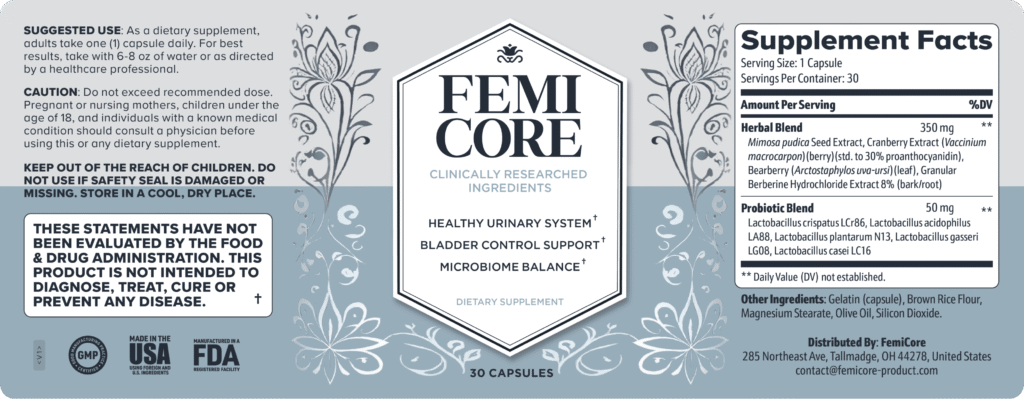
One of the most useful parts of any FemiCore review is examining the formula itself.
The product information currently available lists four botanical ingredients and five Lactobacillus probiotic strains.
These include:
Botanical Ingredients
- Mimosa pudica
- Cranberry extract
- Bearberry (Uva ursi)
- Granular berberine
Probiotic Strains
- Lactobacillus crispatus
- Lactobacillus acidophilus
- Lactobacillus plantarum
- Lactobacillus gasseri
- Lactobacillus casei
The exact amounts and labeling details should always be confirmed against the Supplement Facts panel on the bottle you receive because online product pages can change.
Cranberry Extract
Cranberry is probably the most familiar ingredient in the FemiCore formula.
Cranberry products have been studied extensively in connection with urinary tract health, particularly regarding the possibility of reducing the recurrence of UTIs in certain populations.
However, results across studies are not perfectly consistent, and the evidence for cranberry should not be interpreted as proof that every cranberry-containing supplement will prevent UTIs.
In other words, cranberry is an interesting ingredient, but the specific formulation and dosage still matter.
Bearberry (Uva Ursi)
Bearberry, also known as uva ursi, is a botanical traditionally associated with urinary wellness.
It contains compounds that have attracted attention in herbal medicine and urinary-health research.
However, natural does not automatically mean appropriate for everyone.
People considering products containing bearberry should pay attention to safety information and discuss supplementation with a healthcare professional when appropriate.
Mimosa Pudica
Mimosa pudica is a botanical included in the FemiCore formula.
The brand associates this ingredient with bladder and urinary support.
However, compared with more extensively studied ingredients such as cranberry, there is less high-quality human evidence specifically establishing the benefits of Mimosa pudica for urinary health.
Therefore, I would treat this ingredient as part of the overall formulation rather than assuming it produces a specific result.
Berberine
Berberine is a naturally occurring plant compound that has been widely researched for several areas of health.
In FemiCore, it is included as part of the botanical blend.
Nevertheless, berberine can interact with certain medications and may not be suitable for everyone.
That’s another reason why reviewing the complete ingredient list with a healthcare professional is a sensible step if you take prescription medication.
FemiCore Probiotics
The other major component of the formula is its probiotic blend.
FemiCore lists five Lactobacillus strains:
- L. crispatus
- L. acidophilus
- L. plantarum
- L. gasseri
- L. casei
Probiotics are often used in women’s wellness products because Lactobacillus species are naturally associated with the vaginal microbiome.
The idea behind FemiCore is therefore broader than simply using cranberry.
Instead, it combines botanical and probiotic ingredients in one daily formula.
Still, the existence of research on Lactobacillus strains does not establish that this exact FemiCore combination will produce a specific outcome.
FemiCore Benefits: What Could You Expect?
The potential benefits of FemiCore should be viewed as supportive wellness benefits, rather than guaranteed medical outcomes.
Based on the product’s positioning and ingredients, the main areas of interest include urinary comfort, microbiome support, and bladder wellness.
1. Urinary Wellness Support
FemiCore is designed to support general urinary health.
Its combination of cranberry, botanical extracts, and probiotics gives it a broader formulation than a basic single-ingredient cranberry supplement.
That may appeal to women who want a more comprehensive daily wellness approach.
2. Microbiome Support
The five Lactobacillus strains are one of the most distinctive features of the formula.
Supporting a balanced microbiome is an important concept in modern women’s health research.
However, the exact relationship between supplementation and individual outcomes can vary considerably.
3. Bladder Comfort
The product is marketed around maintaining healthy bladder function and urinary comfort.
For someone dealing with occasional urinary discomfort or concerns about bladder wellness, this may be one of the reasons to consider the formula.
However, persistent symptoms should always be evaluated medically instead of being automatically attributed to a simple imbalance.
4. Convenient Daily Routine
Another practical benefit is simplicity.
The current product information describes FemiCore as a once-daily capsule.
For people who already take supplements regularly, this can make the product relatively easy to incorporate into a daily routine.
Can FemiCore Prevent Recurring UTIs?
This is one of the most important questions surrounding FemiCore.
The answer requires some nuance.
Certain ingredients in the formula, particularly cranberry, have been investigated for their potential role in reducing recurrent UTIs.
Likewise, researchers have studied Lactobacillus strains in relation to vaginal and urinary microbiome health.
But that does not mean FemiCore itself has been clinically proven to prevent recurrent urinary tract infections.
I would therefore be cautious about any advertisement that promises that FemiCore will prevent every future UTI.
A supplement should not be presented as a replacement for medical evaluation or antibiotic treatment when an infection is present.
FemiCore Side Effects and Safety
Before starting any supplement, safety should come before potential benefits.
FemiCore is marketed as a natural, stimulant-free formula, but that doesn’t mean every ingredient is appropriate for every person.
Individual reactions can vary.
Possible Digestive Effects
Probiotic and botanical supplements can sometimes cause digestive changes, particularly when someone first introduces them into their routine.
Possible issues may include:
- Mild stomach discomfort
- Changes in bowel movements
- Bloating
- Nausea
If symptoms are persistent or severe, discontinue use and seek medical advice.
Potential Ingredient Interactions
The bigger concern for some users may be medication interactions.
Berberine, for example, can affect how the body processes certain medications.
Therefore, people taking prescription drugs should not assume that a supplement is automatically safe simply because it contains plant-based ingredients.
Who Should Consult a Doctor First?
Speak with a healthcare professional before taking FemiCore if you:
- Are pregnant or breastfeeding
- Take prescription medication
- Have kidney or liver problems
- Have a chronic medical condition
- Have a history of recurrent UTIs
- Have unexplained urinary symptoms
- Are currently experiencing symptoms of an infection
Check the Current FemiCore Offer
FemiCore and Active UTI Symptoms
This deserves its own section because it can be easy to confuse prevention with treatment.
If you’re experiencing symptoms such as:
- Burning or pain while urinating
- Frequent or urgent urination
- Blood in the urine
- Fever
- Chills
- Back or side pain
you shouldn’t rely on FemiCore alone.
These symptoms may require medical evaluation.
In particular, fever, chills, back pain, vomiting, or feeling seriously unwell can be signs that require prompt medical attention.
FemiCore is a supplement, not an antibiotic.
How to Take FemiCore

The current product information recommends one capsule per day with a full glass of water.
For best consistency, it’s generally easier to associate a daily supplement with an established habit, such as breakfast.
However, always follow the instructions included with the product you actually purchase.
Don’t increase the recommended serving in an attempt to get faster results.
More isn’t necessarily better.
How Long Does FemiCore Take to Work?
There is no scientifically established timeframe that guarantees when an individual will notice results from FemiCore.
Some users may notice changes in how they feel sooner, while others may not notice anything immediately.
It’s also important to remember that urinary symptoms can have many causes.
For that reason, I wouldn’t recommend judging the product based on a few days of use.
Instead, if you and your healthcare professional decide that a supplement is appropriate, monitor your overall experience and pay attention to any changes in comfort, urinary habits, and potential side effects.
FemiCore Reviews: What About Customer Experiences?
Online FemiCore reviews tend to focus on themes such as urinary comfort, bladder confidence, and convenience.
Some testimonials published on product pages describe users reporting improvements after several weeks of consistent use.
However, testimonials are not the same as controlled clinical trials.
A customer’s experience can be genuine while still not proving that the product will work in exactly the same way for someone else.
Therefore, customer reviews can be useful for understanding user experiences, but they shouldn’t be treated as scientific evidence.
FemiCore Pros and Cons
| Pros | Cons |
|---|---|
| Convenient daily capsule | Individual results may vary |
| Combines botanical and probiotic ingredients | Not a treatment for active UTIs |
| Includes multiple Lactobacillus strains | Some ingredient amounts may be difficult to evaluate |
| Stimulant-free according to the brand | Potential medication interactions |
| Focuses on women’s urinary wellness | Independent finished-product clinical evidence appears limited |
| 60-day guarantee advertised by the brand | Should be evaluated carefully by people with medical conditions |
Is FemiCore Legit?
Based on the available product information, FemiCore is presented as a dietary supplement with a defined formula, usage instructions, and a manufacturer website.
However, “legitimate supplement” and “clinically proven treatment” are not the same thing.
That’s an important distinction.
The current FemiCore disclaimer states that the product’s statements have not been evaluated by the FDA and that the supplement is not intended to diagnose, treat, cure, or prevent disease.
So, I would consider FemiCore a supplement for urinary wellness, rather than a clinically established treatment for recurrent UTIs.
Check the Current FemiCore Offer
Is FemiCore FDA Approved?
No.
FemiCore should not be described as an FDA-approved medication.
The official disclaimer specifically states that the product is a dietary supplement and that its statements have not been evaluated by the FDA.
Also, claims about an FDA-registered manufacturing facility should not be confused with FDA approval of the product itself.
Those are two different things.
FemiCore Price and Money-Back Guarantee
FemiCore’s pricing can vary depending on the current offer and package selected.
Some current product pages advertise a 60-day money-back guarantee.
Because online offers can change, it’s best to verify the current price, package details, shipping costs, and refund terms directly before placing an order.
What I Would Check Before Buying
Before completing an order, check:
- Current price per bottle
- Number of capsules per bottle
- Shipping costs
- Money-back guarantee terms
- Return requirements
- Whether the purchase is a one-time order or subscription
- Current Supplement Facts label
This can prevent unpleasant surprises later.
Who Might Consider FemiCore?
FemiCore may be worth considering for adult women who are interested in a daily supplement focused on urinary and bladder wellness.
It may appeal particularly to someone looking for a formula that combines:
- Cranberry
- Botanical extracts
- Multiple Lactobacillus strains
- Daily microbiome support
- A simple capsule routine
However, women with recurring or unexplained urinary symptoms should prioritize medical evaluation rather than relying exclusively on a supplement.
Who Should Probably Avoid Self-Treating With FemiCore?
I’d be more cautious if you:
- Currently have UTI symptoms
- Have recurring infections without a confirmed cause
- Are pregnant
- Are breastfeeding
- Take multiple medications
- Have kidney disease
- Have liver disease
- Have significant urinary or pelvic symptoms
In these situations, getting professional advice is more important than experimenting with supplements.
Final FemiCore Review: Is It Worth Trying?
After looking at the ingredients, intended benefits, safety considerations, and available product information, FemiCore is an interesting option in the women’s urinary wellness category.
Its biggest distinguishing feature is the combination of botanical ingredients and multiple Lactobacillus probiotic strains rather than relying exclusively on cranberry.
That said, I would keep expectations realistic.
There is a meaningful difference between evidence supporting individual ingredients and evidence proving that the finished FemiCore formula prevents recurring UTIs.
The current information I found does not establish strong independent clinical evidence for FemiCore itself as a treatment or guaranteed preventive solution.
Therefore, I wouldn’t recommend buying it because you expect a guaranteed result.
Instead, it may make sense for someone looking for a convenient daily urinary wellness supplement who understands its limitations and is comfortable with the ingredient profile.
My Bottom Line
FemiCore is worth considering as a women’s urinary wellness supplement, but it should not be treated as a cure or replacement for medical care.
If you’re interested in trying it, review the current ingredients, check the return policy, and make sure the formula is appropriate for your individual circumstances.
And if you’re currently experiencing symptoms that could indicate a UTI, don’t wait for a supplement to solve the problem. Get proper medical advice.
Check the Current FemiCore Offer
Frequently Asked Questions About FemiCore
What is FemiCore?
FemiCore is a dietary supplement marketed for women’s bladder, urinary, and microbiome wellness. Its formula combines botanical extracts with Lactobacillus probiotic strains.
What ingredients are in FemiCore?
The current product information lists Mimosa pudica, cranberry extract, bearberry, granular berberine, and five Lactobacillus strains: L. crispatus, L. acidophilus, L. plantarum, L. gasseri, and L. casei.
Does FemiCore contain probiotics?
Yes. FemiCore’s formula includes five Lactobacillus probiotic strains.
Does FemiCore prevent UTIs?
FemiCore is marketed around urinary and microbiome support, but there is not enough independent evidence to say that the finished product guarantees prevention of recurrent UTIs. It should not replace medical treatment for an active infection.
Can FemiCore treat an active UTI?
No. FemiCore is a dietary supplement and should not be used as a substitute for professional diagnosis or treatment of an active urinary tract infection.
Does FemiCore have side effects?
Individual reactions can vary. Some people may experience digestive discomfort or other reactions to individual ingredients. People taking medications should check with a healthcare professional before using the product.
Is FemiCore FDA approved?
No. FemiCore is marketed as a dietary supplement, and the product’s FDA disclaimer states that its claims have not been evaluated by the FDA.
How do you take FemiCore?
The current product information recommends one capsule daily with a full glass of water. Always verify the directions on the label of the product you receive.
How long does FemiCore take to work?
There is no guaranteed timeframe for results. Individual experiences can differ, and urinary symptoms should not be ignored while waiting for a supplement to work.
Is FemiCore worth buying?
For someone interested in a convenient supplement combining botanical and probiotic ingredients for general urinary wellness, FemiCore may be worth considering. However, it should be viewed as supportive supplementation rather than a proven treatment for recurrent UTIs.